

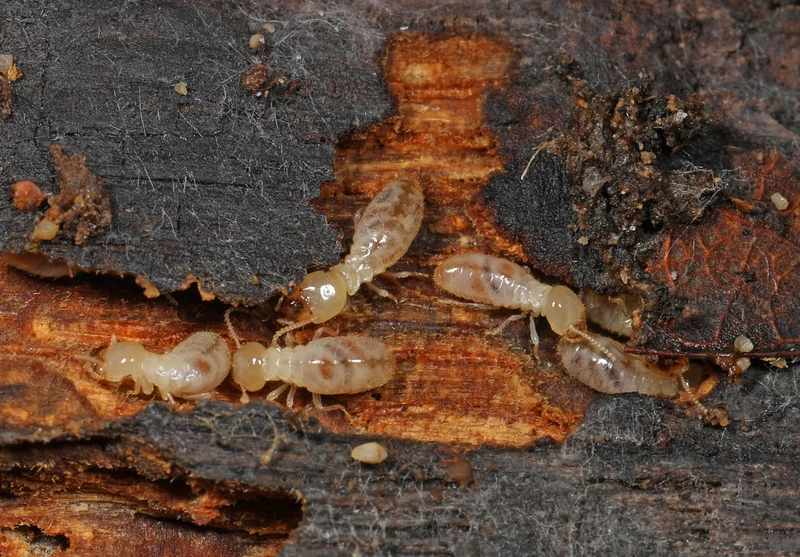
Judy Gallagher · CC BY 2.0 · Resized.
Termites do not all look alike
Termite appearance varies by caste and life stage. Workers are pale and wingless; soldiers have larger heads and mandibles. Swarmers are the winged reproductive stage, and their darker bodies can be confused with winged ants.
Illustrated identification comparison
Termite swarmer or winged ant?
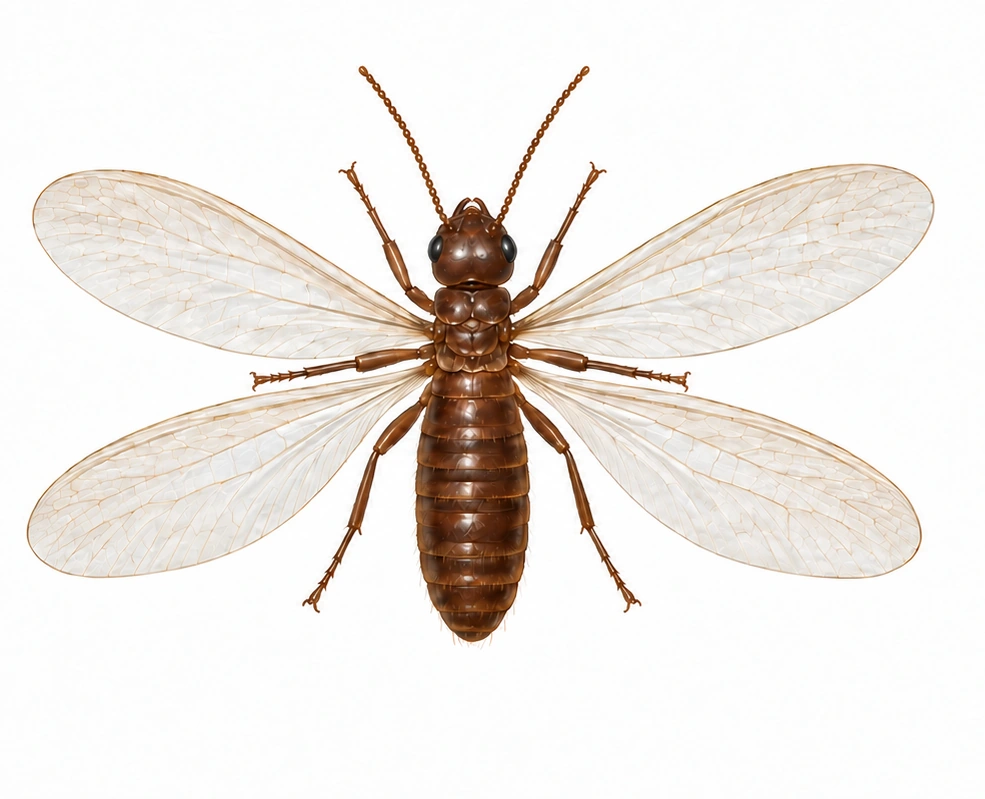
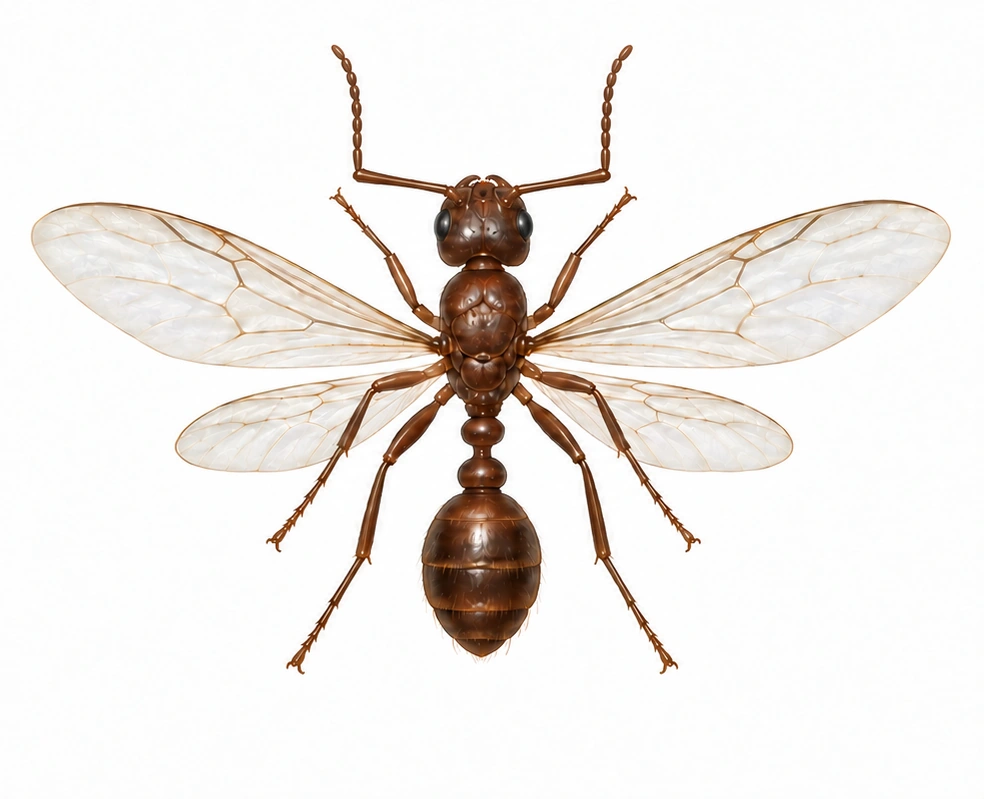
Not shown to scale. These simplified illustrations show distinguishing features; they are not photographs or an exact representation of every species.
Termite swarmer
- Antennae
- Relatively straight
- Waist
- Broad, less constricted
- Wings
- Front and rear pairs broadly similar in size
Winged ant
- Antennae
- Elbowed
- Waist
- Narrow, constricted
- Wings
- Front wings larger than rear wings
Original illustration created for Orange Mango. Morphology reference: Missouri Department of Conservation’s termite guide. This is educational artwork, not field evidence.
Still not sure what you’re seeing?
You do not need to identify the insect yourself. For suspected termite activity, Orange Mango offers a free termite inspection/evaluation; you do not need to be certain you have termites. The free evaluation does not include an NPMA-33 report. Real-estate and formal WDI/NPMA-33 inspections and reporting are a separate paid service.
For ant activity, explore Ant Control. For more on ant activity, see the Ant guide.
Possible mud tubes or discarded wings are worth reporting, but a photograph or sign alone may not establish active infestation. Leave evidence undisturbed; note its location and share a photograph taken from a safe position.
What should you do with possible termite evidence?
- Note the exact location and date. Take a photo from an accessible position.
- Keep previous inspection or treatment records available.
- Ask before removing or covering suspected evidence during repairs.
- Request a free suspected-termite evaluation. For a closing or NPMA-33 report, request the separate paid WDI service.
For general termite biology, mud tubes and wood-related signs, see UC IPM’s termite guide. Its regional species and seasonal notes describe California; they are not a Missouri treatment calendar.
Signs of possible termite activity
In Missouri, subterranean termites may leave pencil-width mud tubes on foundation walls, crawlspaces or other routes between soil and wood. Swarming insects or discarded wings near windows, soft or hollow-sounding wood, and new bubbling paint can also be worth investigating. These signs are not proof on their own—water damage and other insects can look similar.
Moisture, wood and termite access
Termites need moisture and access to cellulose materials. Wood-to-soil contact, drainage that keeps a foundation damp, mulch piled high against siding and stored lumber close to the building can make a property easier to investigate. Activity may remain hidden behind walls or under flooring for a long time.
Reduce wood-to-soil contact and preserve evidence
Keep gutters and downspouts moving water away from the foundation, maintain visible clearance between soil or mulch and siding, and avoid stacking firewood directly against the structure. Do not tear away a suspected tube before an inspection; a photo and its location are useful clues.
When to request a termite evaluation
Request an inspection promptly when you find mud tubes, swarmers or unexplained wood damage. Orange Mango can assess accessible areas and explain whether baiting, monitoring or another next step is appropriate.
Termites: common questions
Should I wait for swarmers before requesting a termite inspection?
No. Report mud tubes, discarded wings or unexplained wood damage when you notice them. Visible swarming is only one possible sign, and the absence of swarmers does not rule out activity.
Do termites always make mud tubes?
No. Tubes are a common sign of subterranean termites, but an absence of visible tubes does not rule out activity.
Information on this page is educational and does not replace a property inspection, medical advice or public-health guidance.
Explore termites service