

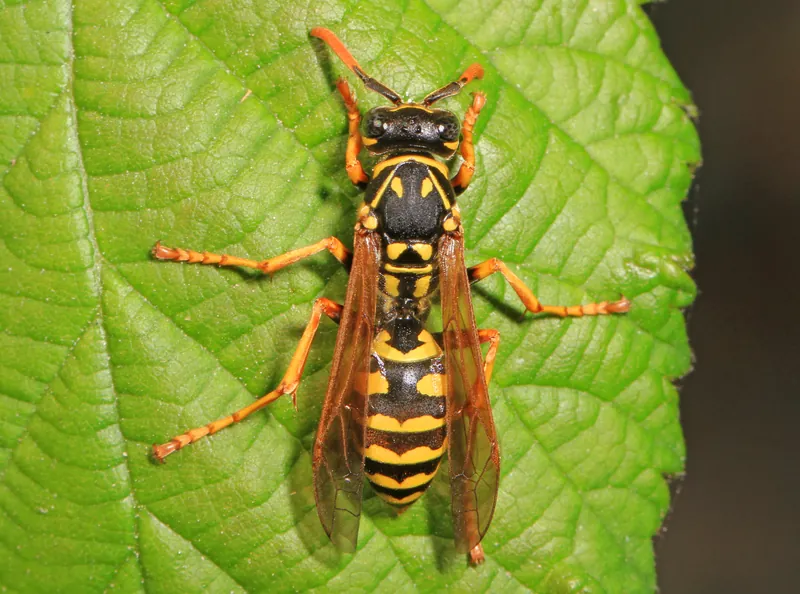
Judy Gallagher · CC BY 2.0 · Resized.

What to look for
Paper wasps and yellowjackets have six legs, antennae, wings and a narrow waist; their colors and body shapes vary. The photograph shows one representative wasp, not every hornet or other stinging insect. Do not approach a nest to compare markings.
What can the nest tell you?
Observe from a distance. Nest construction and repeated flight paths are useful clues, but you should not approach a nest to confirm an insect’s markings.
| Concern | What you may observe |
|---|---|
| Paper wasps | An exposed, open-celled paper comb under a sheltered surface |
| Yellowjackets | Traffic into a ground or wall opening; some species build enclosed aerial paper nests |
| Hornet-like aerial nest | An enclosed paper nest is a reason to identify the occupant, not to judge safety by its common name |
| Possible bees | Do not assume every yellow-and-black insect is a wasp. Request identification before choosing treatment. |
UC IPM’s social-wasp guide explains nest differences and why disturbance can provoke defensive behavior. Keep people and pets clear, avoid sealing an active entrance and provide the nest’s location and approximate height when contacting us.
Nest and flight-path clues
Repeated flights to one opening, buzzing around a soffit or deck, or a visible paper nest can point to wasp, hornet or yellowjacket activity. Yellowjackets may nest in the ground or wall voids, while paper wasps often build open nests under eaves and outdoor structures. Keep your distance—behavior and nest placement are more useful than trying to get a close look.
Why wasps use sheltered spaces
Protected cavities, eaves, sheds, decks and ground voids create places to nest. Food and drink outdoors can also draw foraging yellowjackets later in the season. Activity tends to become more noticeable as colonies grow through summer.
What to do around a suspected nest
Keep people and pets away from an active nest, use another entrance if possible and do not block a nest opening or strike the nest. Note its location, height and whether activity seems to enter a wall or ground opening.
When to request a wasp or hornet inspection
Schedule help when the nest is near a doorway, play area, work zone or anyone with a known sting allergy. A trained professional can evaluate the nest type and access before deciding on the right approach.
Wasps & hornets: common questions
Are hornets and yellowjackets the same?
They are related social wasps, but nest style, behavior and appearance can differ.
Should I spray a nest myself?
Disturbing an active nest can provoke stings. Keep clear and seek appropriate help, especially for difficult-to-reach nests.
Information on this page is educational and does not replace a property inspection, medical advice or public-health guidance.
Explore wasps & hornets service